You paint the walls, arrange the furniture and finally hang the artwork. The room looks finished during the day. Then evening arrives, the ceiling light comes on, and the whole space feels strangely ordinary again.
The problem is often the fixture left behind by a previous owner or builder. It may provide enough light, but its size, shape or colour has no relationship to anything else in the room. Because a ceiling light sits above the main sightline, it is easy to ignore while decorating. Once illuminated, however, it affects every surface below it.
Look Up from the Doorway
Stand in the doorway and look at the room as a complete picture. Does the ceiling fixture appear connected to the furniture, or does it look like a small object floating in empty space? A common mistake is choosing a light that is compact enough for the ceiling but visually too small for the room.
This happens frequently in bedrooms. A tiny fixture centred above a king-size bed can make the ceiling feel bare, even when the room is not especially large. A broader design may sit close to the ceiling while still giving the space a stronger focal point.
When browsing flush mount lighting, pay attention to diameter as well as depth. Two fixtures can project the same distance from the ceiling yet have completely different visual weight. A wide, slim light often feels calmer than a small, bulky dome because it relates better to the area below it.
The low profile preserves an open feeling, while the wider diameter suits the scale of the bed.
The Centre of the Ceiling May Be the Wrong Centre
Builders usually place an electrical box in the mathematical centre of a room. Furniture creates a different centre. A bed may shift towards one wall to leave space for a dresser. A living room may be organised around a fireplace, while the ceiling box remains centred between four walls.
This mismatch is not always serious enough to justify moving the wiring. It can often be softened by choosing a fixture with a balanced shape that does not point strongly in one direction. Circular and symmetrical designs are forgiving. A long rectangular light or an asymmetric branch fixture makes alignment more obvious and needs more careful positioning.
Before choosing a directional design, place painter’s tape on the ceiling to represent its length and orientation. Then check it from the doorway, sofa and main walkway. If the taped outline appears to lean towards one side of the room, the installed light probably will too.
A Hallway Light Should Not Be an Afterthought
Hallways often receive the smallest and plainest fixtures in the house, yet these spaces are viewed more frequently than formal dining rooms. A hallway ceiling light is visible whenever someone passes from one room to another. It can also be seen alongside several door frames, which makes poor scale or an unrelated finish easy to notice.
A decorative flush mount can give a hallway character without adding furniture or reducing the width of the passage. Glass, crystal or a patterned diffuser introduces detail overhead while keeping the walls clear.
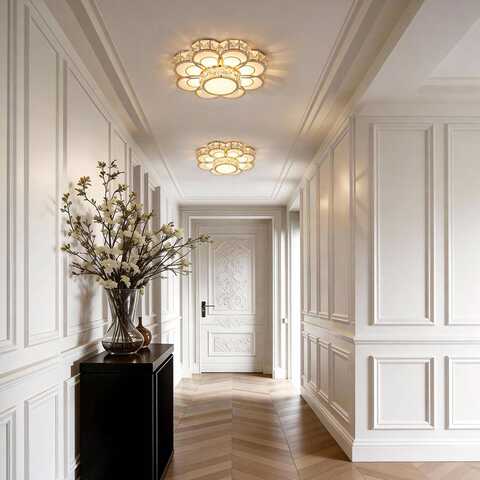
A small amount of texture overhead can make a plain passage feel deliberately designed.
Spacing matters when a long hallway has several lights. Fixtures should create a steady visual rhythm rather than leaving one end noticeably darker. Check where doors interrupt the walls and where the hallway opens into another room. The ideal spacing on a floor plan may look awkward when one light appears directly against a doorway.
Repeat a Finish, but Do Not Match Everything
A ceiling light feels more settled when one of its finishes appears elsewhere in the room. A black frame might relate to window trim or chair legs. Brass can pick up a cabinet handle, mirror frame or small detail in the artwork. Wood can connect the ceiling to flooring or furniture.
The repetition does not need to be exact. Mixing a softly aged brass light with warmer metal accents often looks more natural than buying every item from one matching collection. What matters is that the fixture does not introduce a completely isolated colour or material.
Pay attention to what happens when the light is off. A white acrylic fixture may almost disappear into a white ceiling during the day. A black geometric design remains visible and behaves more like ceiling sculpture. Neither approach is wrong, but the choice should be intentional.
Sometimes the Ceiling Needs a Little Shadow
A completely flush fixture sends most of its light downward or outward through a diffuser. This works well when the goal is even, practical illumination. In a living room or bedroom, however, a small gap between the fixture and ceiling can create softer reflected light and make the ceiling itself part of the atmosphere.
This is where semi-flush mount lights can be useful. Their short drop gives the design more shape without creating the long suspension of a chandelier. They can introduce curved arms, globes, leaves or branch-like forms while remaining relatively close to the ceiling.

The branching shape fills the ceiling visually and relates to the width of the seating area below.
The extra depth also creates shadows around the fixture. That can add warmth and dimension, particularly in a room with a plain ceiling. It can also highlight uneven plaster or a badly patched electrical box. Switch on a temporary work light aimed towards the ceiling before installation; it may reveal repairs worth making first.
Check the Old Fixture’s Footprint
Removing an older ceiling light often exposes an unpainted circle, faded paint or a ridge where the previous canopy met the ceiling. Measure the old canopy before ordering the replacement. A new base that is slightly wider can cover the mark and save an unexpected afternoon of sanding and repainting.
If the new canopy is smaller, plan the ceiling repair before the electrician arrives. Fresh paint applied around an installed fixture is difficult to keep neat, and moving the light twice adds unnecessary work.
Judge the Room at Night
A ceiling fixture should be assessed when it is doing its actual job. Turn off the lamps and check whether the centre light creates glare, leaves the corners gloomy or changes the colours of the walls. A warm white room can look grey under a very cool bulb, while an overly warm source may dull blue or green finishes.
Then switch the lamps back on. In most rooms, the ceiling light should work with smaller light sources rather than overpower them. A dimmer gives more control, but only when the fixture and its bulbs are compatible.
The right ceiling light does not need to become the most dramatic item in the room. It simply needs enough scale, shape and light quality to belong there. When those details are right, the furniture no longer appears to stop at the walls—the entire room, including the ceiling, finally feels complete.
Read More: fliz movies list
Leave a Reply